You’ve spent hours meticulously planning the lighting layout for your new kitchen, home theater, or expansive retail store. The LED strip lights arrive, carefully cut to perfection, beautifully mounted in their channels. You flip the switch, and… the first meter blazes with brilliant light, but the far end looks noticeably dimmer and perhaps even tinged with an unpleasant yellow hue.
If this scene sounds familiar, you’ve just encountered the most common technical pitfall in the world of large-scale LED installation: voltage drop.
This guide will explain exactly what voltage drop is, why it happens, and—most importantly—how to fix it so that your next installation is perfectly uniform from the first LED to the last.
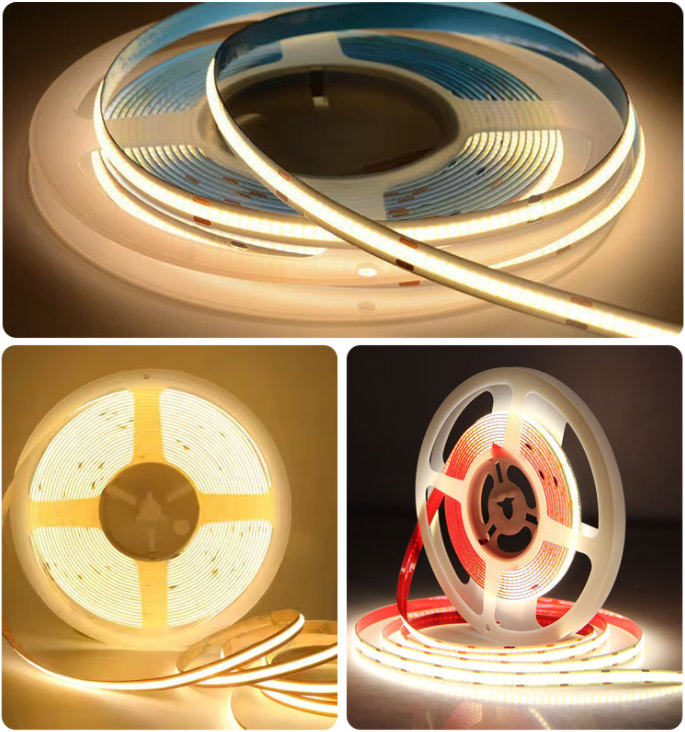
Voltage drop is the gradual loss of voltage as electrical current travels along a length of wire. In the context of LED strip lights, the flexible copper traces on the circuit board have a small amount of natural resistance. As current flows from the power supply to the farthest end of the strip, this resistance eats away at the voltage, causing the last few meters of the run to receive significantly less power than the very beginning.
This single phenomenon is the number-one reason why beautiful lighting projects end up looking patchy and unprofessional. The result is an installation that is bright at one end and disappointingly dim at the other.
You might think a slight dimming at the end is a minor cosmetic issue—but in reality, voltage drop can sabotage an entire project in three critical ways:
Uneven brightness that makes the installation look cheap and inconsistent.
Color shifting, where white light turns yellow or warm at the far end, ruining the intended aesthetic.
Increased system stress, as early segments run hotter while fighting to compensate for the lack of power down the line, potentially shortening the life of the waterproof LED strip in your patio project.
Most standard 12V LED strips can run approximately 5 meters (16 feet) before noticeable voltage drop sets in. 24V strips, which require half as much current to deliver the same power, can typically reach 10 to 15 meters (32 to 50 feet) before the same problem appears.
If your project is going to exceed these baseline distances—whether you are illuminating a long hallway, a commercial display shelf, or a massive outdoor deck—you have four effective strategies to keep the entire run uniformly bright.
Prevention is always better than cure. Choosing a 24V strip instead of a 12V alternative is the single most effective way to double your maximum uniform run length before any additional intervention is required.
If your priority is aesthetics, a COB LED strip lights product is an exceptional choice for exposed installations. Unlike traditional SMD strips that can still show individual dots on a ceiling, COB strips visually eliminate all hotspots and deliver a completely uniform, seamless beam of light across very long distances. By voluntarily upgrading to a 24V COB strip, you are proactively solving both the voltage drop problem and the cosmetic issue of visible hot spots in a single step.
For significantly longer runs (from 10 to 20 meters), you can overcome resistance by delivering power from two locations instead of just one. This technique is called dual-end power injection or loop feeding.
Imagine two fire trucks pumping water into a long pipeline from both ends—the middle receives a powerful flow from both directions simultaneously. In an LED installation, you would connect your primary power supply to both the very beginning and the very end of the long LED strip.
By energizing the far end as well, you are effectively halving the distance any single electron has to travel. The result is that the middle of the strip receives a strong and balanced current from both sides, eliminating the fade that normally appears at the tail.
If your project consists of several shorter independent runs (for example, multiple floating shelves in a retail display or various kitchen cabinets spaced apart), the best engineering solution is to wire all of them in parallel.
With a parallel configuration, each shelf or cabinet receives its own dedicated wire that goes directly back to the main power supply hub. No single strip has to carry current for the next one, so every run receives identical voltage and thus identical brightness. This method guarantees perfect uniformity across a sophisticated multi‑zone installation.
For the most demanding scenarios—perimeter lighting for a massive conference room, garden path illumination, or long commercial runs—you can combine the previous strategies by cutting a very long strip into two or three shorter segments and powering each segment with its own dedicated, locally placed power supply.
This installation technique is best accommodated using an LED aluminum channel that can hide the gaps where you have inserted these small auxiliary power injections. The result is a seamlessly lit, perfectly bright run that can extend to 30 meters or more without any sign of fading.
By far the most frequent mistake beginners make is buying a standard 12V RGB strip, running a 20-meter line around an entire room, and then being frustrated when the final corner is hopelessly dim. If you remember just one thing from this guide, let it be the golden rule: 12V for 5 meters, 24V for up to 15 meters, and parallel injection for everything beyond.
At Gming LED, we provide exactly the tools you need to install confidently. Our comprehensive catalog of LED strip lights includes 24V options for longer runs, our premium COB LED strip lights deliver seamless graphics without spots, and a full range of LED aluminum channel accessories accommodates hidden connectors and auxiliary power supplies. Browse our collection to find the perfect match for your next large-scale project.
Not sure which voltage or power-injection method is right for you? Contact our team with your project specifications and pictures. We are ready to help you engineer a lighting system that is uniformly bright from beginning to end.
 English
 français
 español
 العربية
 한국의
한국의

 우리 매장
우리 매장


 IPv6 네트워크가 지원됩니다
